
End Learning Poverty
In Humana People to People, we believe that education is a fundamental human right and the foundation for peace. It has the power to promote and embrace solidarity, diversity, inclusiveness, and sustainable development.
In late 2025, the African Union launched a new campaign to “end learning poverty, update skills, and modernise education systems.” The campaign is a continental commitment to spotlight education over the next decade.
Rethink, Repurpose, and Reshape Education
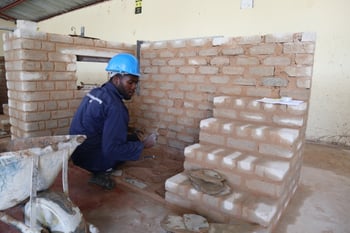 On this Africa Day, 25 May 2026, we join their call. We must all keep up the pressure to rethink, repurpose, and reshape education. One of the questions we need to ask is what 21st-century education looks like in practice, and what kind of education equips young people to build the lives they want and the world needs.
Across many African countries, the challenge is no longer only about access. Millions of young people are completing school or training but still struggle to find work, start businesses, or apply what they've learned. Meanwhile, communities and local economies need exactly the practical skills, entrepreneurship, and problem-solving that current systems often fail to deliver.
Filling the Gap
This is the gap that Technical and Vocational Education and Training (TVET) is positioned to close when it is relevant, practical, and connected to real opportunities: training that reflects local demand, combines technical skills with entrepreneurship, and prepares young people to move directly into work or self-employment. Many African countries are already moving in this direction, and this is where Humana People to People has worked for over four decades.
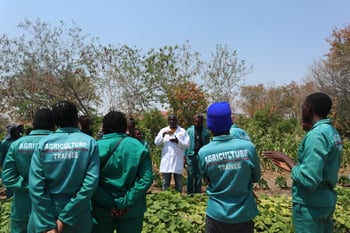
As Humana People to People, we have learned a simple yet powerful lesson from decades of working alongside communities: education is not delivered; it is built together. With a longstanding presence in education and skills development across eight African countries, we connect learning, livelihoods, and community development. Our work bridges the gap between education and opportunity through practical, real-life training that enables young people to work and earn a living, or start their own ventures.
The TVET Effect
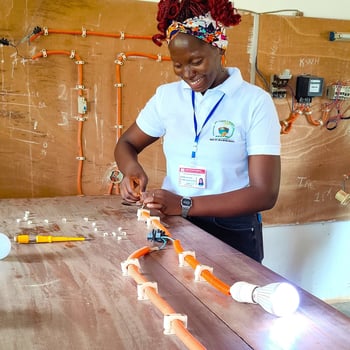 Since 1981, more than 36,000 young people have graduated from our 16 vocational training centers across eight African countries. A few examples:
In Guinea-Bissau, students at the Vocational School in Bissorã learn in a practice-theory environment, installing solar panels, wiring buildings, repairing engines, and supporting local construction projects. Each year, 300–350 young people leave the school ready to provide these services in their own communities. Celina Sanha, a recent graduate, put it this way:
"My goal is to establish an electricity team in my community. I want to inspire other girls to believe in themselves."
In Malawi, DAPP Mikolongwe has trained more than 15,000 young people since 1997 in trades ranging from welding to tailoring, paired with entrepreneurship training and start-up kits. The result: graduates not only find jobs but create them. 45 tailoring shops have been launched in rural areas by women graduates alone.
 In Mozambique, students learn climate-smart agriculture, irrigation, soil management, and post-harvest processing, directly linked to local value chains, enabling them to produce, process, and sell rather than only grow.
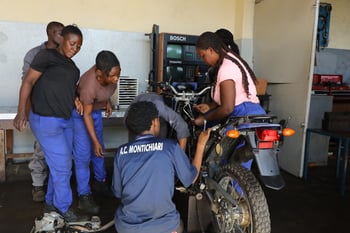
In Zimbabwe, students in trades such as motor vehicle maintenance and construction complete industrial attachments lasting up to a year before graduating, gaining practical work experience before entering the labour market or starting their own activities.
Similar work is underway in our other program countries. Across it all, the common thread is the same: training follows real opportunities, not the other way around. It is built with communities, governments, and private-sector partners who help shape what's taught and absorb graduates into the workforce.
In our experience, education fit for the 21st century is not only about access and receiving a certificate. It is about the skills young people can actually use to earn, to build, and to contribute to the economies around them. Where that connection holds, stronger livelihoods follow. So do more resilient communities.
This Africa Day serves as a reminder that we must invest in young people so they can build livelihoods, support families, strengthen local economies, and contribute to resilient nation-building. By strengthening education and skills systems today, Africa can unlock the full potential of its next generation.