
At the 26th International AIDS Conference (AIDS 2026) in Rio de Janeiro, scheduled for July 26 –31, 2026, Humana People to People supports the power of community-led HIV prevention to strengthen current and future strategies to End AIDS by 2030. This year’s theme, “Rethink. Rebuild. Rise.” is a call to make bold decisions, key to ending HIV as a public health threat.
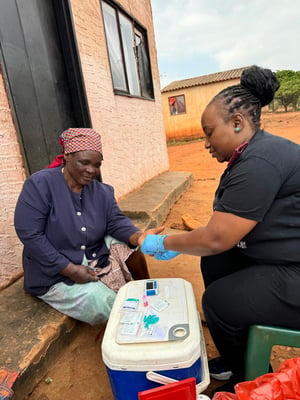 We maintain that communities must lead the HIV response because local people are not passive recipients of aid, but the unique drivers of progress who possess the essential cultural trust, language skills, and ground-level knowledge required to reach those most likely to be left behind. Grounded in our Total Control of the Epidemic (TCE) philosophy that "only the people can liberate themselves from AIDS," we value local communities' active participation, as it is critical in developing local agency, breaking down systemic stigma, driving localized innovation, and sustaining long-term behavioral change.
Ending HIV as a public health threat requires sustained investment in community-led HIV prevention. For the past 25 years, Humana People to People has worked alongside communities in sub-Saharan Africa and Asia to lead HIV prevention through organized, community-led programs that are central to prevention, testing, and linking people to life-saving treatment. Since 2000, over 29 million people have been engaged across 12 countries in Africa and Asia.
We are excited to announce our participation in the International AIDS 2026 conference through eight delegates from our Humana People to People members in sub-Saharan Africa, Brazil, and the USA. We will hold four presentations to share factual, data-driven findings, highlighting transformation and high-impact, people-centred responses.
 At AIDS 2026 in Rio de Janeiro, Planet Aid/Humana People to People and Global Leaders Network co-host a high-level side event on July 29 at 6:00 -7:30 PM (BRT). The theme is"Leading for the Future: Re-centring Women, Children and Adolescents as a Pathway to Sustained HIV Epidemic Control."
The keynote speaker for the event is Winnie Byanyima (UNAIDS Executive Director), who will address a panel that includes government ministers, global philanthropists, and civil society. The event seeks to chart a course toward political leadership, sustainable financing, and locally led partnerships.
Decades of frontline experience have taught us a fundamental truth: community-driven health projects succeed when people take full control of their own health challenges. Community-led HIV prevention meets people exactly where they are - in their villages, their homes, and their local community spaces.
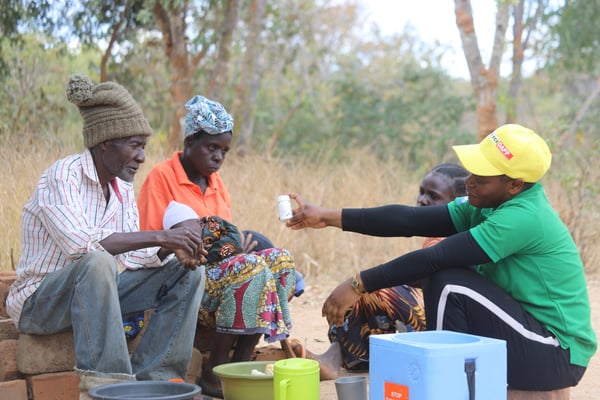
Getting a diagnosis is just the first step; staying on antiretroviral therapy (ART) requires continuous, holistic support. We shift the focus from centralized clinics directly to the community level. By establishing and training local community health worker networks, we break through long-standing barriers of stigma, fear, and misinformation. Through personalized treatment support, we set up functional community HIV treatment adherence groups.
Close family members form a TRIO responsible for supporting the timely uptake and collection of ART drugs. Watch the film to see how our member, DAPP Zambia’s TCE Lusaka, is linking people to life-saving HIV treatment support at the community level.
In Malawi, DAPP Malawi is implementing TCE Loto-Langa, an HIV prevention initiative that has engaged over 100,000 Adolescent Girls and Young Women - a demographic disproportionately affected by HIV. Building on that reach, TCE Loto-Langa has blended comprehensive HIV prevention with economic empowerment and linked those at high risk to treatment support. More girls and young women are making informed choices, protecting their health, and building a safer and brighter future. Watch the transformation in Rhoda Chikopa’s life, one of the supported adolescent girls.